Job ticket · beside the outseam
Two rips. One patch. Then two stitches.
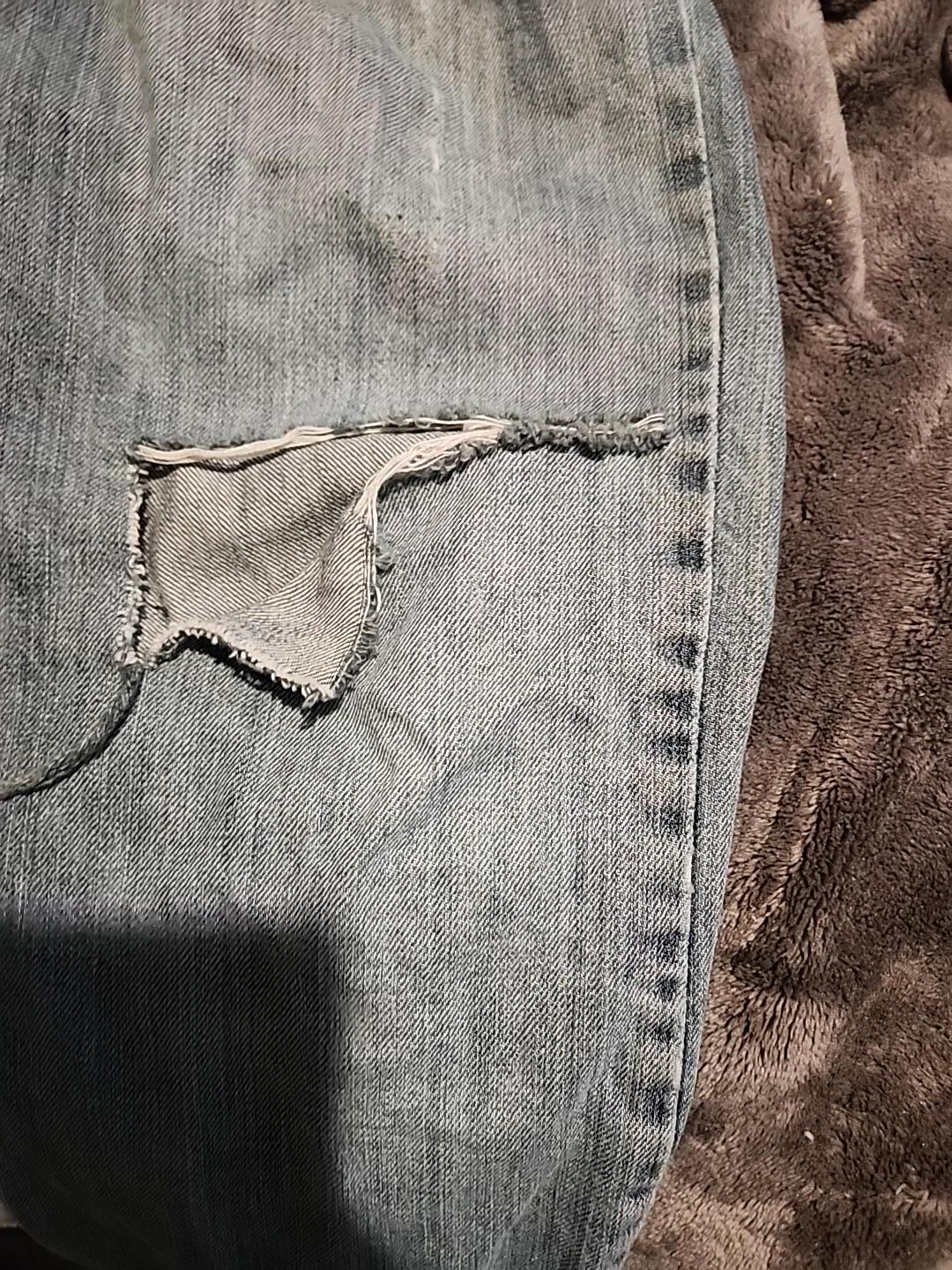
The denim split on the crosswise grain and a flap dropped open, so the pale reverse is what you’re looking at. The white threads across the top are broken weft. The right end runs into the seam.
Don’t ladder the hole shut with nothing behind it. The yarns are already gone at the fray. Put one denim patch behind both rips. Ladder the upper split. Whip the flap down, and backstitch its point.
01
Patch
One piece of denim behind both rips. Interfacing alone will not hold this.
02
Ladder
Close the upper split, the white-weft one, with hidden stitches.
03
Bartack
Five short stitches where that split dies beside the outseam.
04
Whip
Lay the flap home and catch its raw edge, then backstitch the point.
Thread
What goes in the needle
For this pair: bonded polyester jeans thread, faded navy, not black and not the pale color of the outseam. Sharp needle, size 7, or a denim needle. A thimble. About 50 cm of thread, waxed, so the ladder doesn’t knot inside the fold. Bring the jeans to the store and match the thread in daylight.
Diagrams draw a light halo under dark thread, and a dark halo under light thread, so you can see the path. Sew it in the color you picked, not in the halo.
Stitches
Five stitches, and which one this tear actually wants
Learn the motion here. The plates after this one put those motions on the jeans — starting the row, locking it off, then each rip.
On this pair: the upper split, the long one.
Plate 03
Basic stitch
Two lips, and a crack
You stitch the fold, not the face. The needle stays inside the cloth except when it crosses.
Solid thread is what shows. Dashed thread is inside the cloth. The needle is drawn larger than life.
1 / 5
On the jeans
Getting it started, then letting it flow
Left end of the upper split. The first two stitches are slow on purpose. After they match, you keep that size and move.
Plate 06
Getting the stitch started
Start in cloth that still holds
Come up about 8 mm before the split, in denim that isn’t frayed. A stitch that starts in the tear pulls out.
Dashed thread slides inside the fold. Solid thread is the cross you might see before you snug it.
1 / 6
On the jeans
Finishing the stitch at the seam
Right end of the same split, where it runs into the outseam. Stop, bartack, then knot on the inside.
Plate 07
Finishing the stitch
Same stitch, seam in sight
Don’t change the stitch because the outseam is close. Flow the last few the same way you started.
The stop line is the last place you stitch. The outseam thread stays untouched.
1 / 6
Both rips
Same patch. Two different closures.
These plates are a schematic of your tear, with the outseam on the right the way it sits in the photo. Rip A is the horizontal split. Rip B is the flap that dropped.
Plate 08
Rip A, the upper split
Rip A — the white-weft split
Straight across the grain, toward the outseam. The pale threads bridging it are the weft that hasn’t let go yet.
The flap is still there, under this split. Close this one first. Plate 09 is the flap.
1 / 6
Plate 09
Rip B, the dropped flap
Rip B — the dropped flap
The cloth peeled down. You’re looking at the pale reverse, with a raw point at the bottom and a loose yarn off the corner.
Pale cloth is the reverse of the flap. Lay it back so the twill matches, then whip the raw edges onto the patch.
1 / 6
Order of work
Do it in this order
About an hour if the patch is already cut. Hand sewing, leg pulled over a rolled towel so you don’t catch the back of the denim.
0 of 11 checked
Machine, if you have one that can reach
Denim needle 90/14 or 100/16. Stitch length about 2.5 mm. Straight stitch the upper split once the patch is in, and reverse a few stitches for the bartack. Stop before the outseam. The point of the flap is still easier by hand — a foot won’t sit in that V.
Afterward: if you fused the patch, let it cool before you wear them. Wash inside out, cold, and hang them. Skip the dryer for the first wash.